
Everyone told me diet had nothing to do with it. Everyone was wrong.
I grew up in a Catholic household in Northern Ireland. Every year, like clockwork, Lent rolled around and I gave up chocolate. It's what you did. Ash Wednesday came, you picked your sacrifice, and you white-knuckled it through to Easter Sunday.
Except... you didn't really, did you? Not properly.
Because strictly speaking, Lent runs from Ash Wednesday to Easter Sunday, and that's more than 40 days (the number of days Jesus fasted in the desert, hilariously often misspelt "dessert" when chocolate is on the line). So, allowances were made. St Patrick's Day? Sure, have a bit of chocolate. It's practically a holy day of obligation. Sundays? Well, technically Sundays aren't part of Lent. And my birthday falls pretty much always during Lent, so that was another exception.

By the time you added up all the legitimate cheat days, I probably never went more than one to two weeks without having milk chocolate during any given Lent. A valiant effort, in fairness. But not exactly the full desert experience.
Then came 2010.
The Year I Did It Properly

For some reason (stubbornness, probably, which is an underrated superpower), I decided that 2010 would be the year of the no-cheat Lent. No St Patrick's Day pass. No birthday exception. No Sunday loophole. Forty-plus days of absolutely no chocolate.
(Stubbornness that, I should mention, eventually led me straight into oxalates. But that's the sequel...)
I would have been an adult of considerable years by that stage. No, I'm not going to tell you exactly how old. You don't need to know that.
What you do need to know is that I'd had severe acne since my teens, and I still had it well into my...
You almost got me there. Still not telling you.
The Medical Merry-Go-Round

Let me paint you a picture of what "doing everything right" looked like for my acne, over the course of many years:
Topical antibiotics. Didn't work.
Oral antibiotics (specifically minocycline). Until they gave me such nausea I couldn't function. Nobody mentioned that I was carpet-bombing my gut microbiome. Nobody told me that the bacteria I was destroying might actually be important for, oh, I don't know, everything. The minocycline also has a rather delightful side effect that nobody warned me about at the time: if you happen to get pregnant on it, it can cause permanent brown-grey tooth discolouration in the baby. Lovely.
Chemical peels. Scrubs. Benzoyl peroxide (the stuff that bleaches your pillowcases and sweaters, and makes your skin feel like it's been sandpapered).

The oral contraceptive pill (Dianette, specifically). The one they give you for acne. It's also quite good at stopping you getting pregnant, which is handy given the teratogenic horrors of some of the other acne drugs. One of the known side effects of Dianette is weight gain. Another is depression. But at least your skin might clear up... Might.
Oral Roaccutane (isotretinoin). The nuclear option. The one where they sit you down and explain that you absolutely, categorically must not get pregnant because it causes horrific birth defects. The one that requires regular blood tests to monitor your liver. The one that dries out your skin, your lips, your eyes, your nasal passages. The one associated with depression, mood changes, and (though pharmaceutical companies have fought hard against this association) suicidal ideation.
The Roaccutane worked. For a few months after the course finished. And then the acne came back. Just as bad as ever.

Topical Roaccutane. Like oral Roaccutane's milder, less effective cousin.
Topical vitamin B5. A more alternative approach. Didn't do much.
Oral traditional Chinese medicine. Tasted like pond water mixed with bark. Which, in fairness, it probably was.
Topical Nurofen (ibuprofen). Because acne is inflammatory, and ibuprofen is anti-inflammatory. Logical, in a desperate sort of way. It works, but I wouldn't recommend it because you absorb topical drugs and their excipients through the skin, and then you have to deal with the toxicity. Which will cost you nutrients you can ill afford to expend.
I'd heard that acne was all due to having the wrong microbes on your skin. It's not... or at least, that's a spectacularly incomplete picture. I'd been told repeatedly, by multiple medical professionals, with great confidence, that acne has nothing to do with diet.

And I believed them. Because why wouldn't you? They're the experts. They went to medical school. They have the degrees on the wall.
They were wrong.
A Few Weeks into Lent
A few weeks into my no-cheat Lent, something happened. Something I'd been waiting for since I was a teenager. My skin started to clear up.
At the grand old age of...
I see what you did there. Let's just say it was an age long past where you'd expect someone to outgrow their acne.
Finally. Finally. My skin was clearing. I thought I'd grown out of it at last. I was overjoyed. After years of trying everything medicine could throw at it, my acne was finally deciding to leave of its own accord.
Easter Sunday arrived, and I celebrated with delicious milk chocolate Easter eggs. As one does.

I didn't wake up the next morning with a spot. In fact, my skin didn't really start getting oily again for 12-24 hours. But gradually, over the next three to five days, the acne started to return.
What the hell?
The Penny Drops (In Slow Motion)
I mean, wtaf? Oh no. Why did that happen? Don't tell me...
No. There's no way. Everyone said diet has nothing to do with acne. Every doctor. Every dermatologist. Diet doesn't cause acne. You just need drugs that can make you suicidal, give you nosebleeds, dry your skin to parchment, make you gain weight, destroy your gut microbiome...
Drugs that you absolutely should NEVER get pregnant on because they'll cause horrific birth anomalies in your offspring (the Roaccutane). Or cause weird, permanent brown tooth discolouration in them (the minocycline). Good thing one of the other drugs also stops you from getting pregnant in the first place (the Dianette pill, which also increases your risk of blood clots, breast and cervical cancer, depression, and gaining weight). A neat little ecosystem of pharmaceutical interventions, each one creating the need for the next.

But just to be sure, I thought I'd try going off chocolate again. For more than a few days straight this time.
And lo and behold. The acne started to clear again. It became far milder.
So that was... interesting.
Down the Rabbit Hole
I started looking into dietary links and acne. Surely someone else had noticed this?
And of course they had. The earliest link I found between diet and acne was from 1916. A paper in the Journal of Cutaneous Diseases by Schwartz, Heimann, and Mahnken (The Sugar Content of the Blood in Various Diseases of the Skin) found that patients with acne had a striking association with high blood sugar. In 30 cases of simple acne, 7 showed increased blood sugar, and of 7 cases of indurated acne, not a single one had normal readings. They noted that the link was specifically with pilo-sebaceous conditions (acne, seborrhoea, sycosis) and not with other skin diseases.
They knew. Over a hundred years ago, researchers had connected blood sugar to acne.
What happened next is a masterclass in how science goes wrong. Subsequent researchers tried to replicate the finding by feeding people glucose (dextrose) and measuring whether their blood sugar spiked. It didn't correlate with acne. They concluded that the diet-acne link was debunked.

But they'd put 2 and 2 together and got 5. Because it wasn't sugar itself (or at least, not dextrose in isolation) that was the primary trigger. It was inflammatory foods causing an inflammatory response that culminated in stress hormones and neurotransmitters shooting blood sugars up. The 1916 researchers had measured the right outcome (elevated blood sugar) but the later researchers tested the wrong mechanism (direct sugar consumption). And from that flawed reasoning, "diet has nothing to do with acne" became gospel. An unchallenged assumption, repeated from textbook to textbook, professor to student, doctor to patient for the next century. Nobody questioned it because everybody "knew" it was true.

The next thing I discovered was that people were reporting milk as a trigger. So, milk was next on the hit list. I replaced it with soy milk, almond milk, and processed plant milks, as one did in 2010.
And what do you know... my skin got better again.
At this point, I was starting to wonder about what our ancestors had actually been eating. I thought, "Oh-ho, I'll develop a revolutionary new diet based on what humans should have been eating before farming came in! Our closest relatives are apes. They mostly eat leaves, fruits, and some animals. I could make a mint on this idea!"
And then I discovered that someone already had. It was called the paleo diet.
So, I fell down the paleo rabbit hole. And before the end of 2010, I'd also got off gluten and white potatoes and started doing a lot more cooking from scratch. On the more adventurous side, I started introducing liver and sardines to my diet... a paleo-plus type of advanced move. I have Liz Wolfe to thank for that particular nudge. Our ancestors ate nose to tail. If you turn your nose up at organ meats like liver, kidneys, heart, brain, and even bone marrow and collagenous cuts like oxtails and ribs, you're rejecting the most nutrient-dense parts of the animal. In some cultures, the organs are prized so much that there are rituals around eating them that are spiritual in many ways.
The Sequel
After Lent cleared my skin, I went paleo. The high-vegetable, green-smoothie, almonds-and-spinach version that everyone was doing at the time. I thought I'd cracked it. I hadn't. I'd just traded one set of problems for another.
Read what happened next →
The Gluten Discovery (and the Kitavans Who Never Get Acne)
But as I explored my diet further, I discovered something even more significant than the chocolate connection. If there's one food that is guaranteed to break my skin out in pimples, it's gluten. And not just pimples. One crumb of gluten and I'm destroyed for weeks... oily skin, mood sinking like a stone, back ache, stomach churning, nausea, vomiting, poor stomach emptying, diarrhoea, joint pains, mouth ulcers, fatigue, poor sleep, and a feeling like someone is putting cigarettes out in my insides. Each symptom slowly appearing and resolving in a steady stream over the course of one to two weeks.
I can eat pineapples and other high-sugar fruit without getting a single pimple. But one crumb of gluten and it's war. Which rather puts paid to the simplistic "sugar causes acne" theory. It's not sugar per se... it's inflammatory foods causing an inflammatory cascade that (among many other things) pushes blood sugar up.

This discovery led me to research by Dr Staffan Lindeberg, who studied the Kitava Islanders of Papua New Guinea. In a population of about 1,200 people eating a traditional diet, Lindeberg found that acne was nonexistent. Not "less common." Nonexistent.
The Kitavans eat fish, coconuts, tubers, and fruit (perhaps as much as 400g of fruit per day). Their daily tuber intake is massive... about 1,200g daily of sweet potatoes, yams, and taro. They also buy some rice, sugar, canned fish, drippings, oil, and (gasps) biscuits. But their average daily intake of Western food was estimated by Lindeberg to be less than 1g. They're not big on dairy, tea, coffee, or alcohol, and they consume very little oil, margarine, cereals (apart from the rice), or refined sugar.

You know what Kitavans don't eat? Gluten. Cereals. Toast. Bread. Pasta. Cakes. Buns. Scones. They also don't eat spinach or rhubarb, which is interesting from an oxalate perspective, though they do eat quite high-oxalate tubers.
Every day sounds like a Lent day for them. And apart from being small and slim, they have low blood pressure (until they hit about 70 years old) and low cholesterol. Yet they smoke. Which really does complicate the tidy narrative about what's "healthy," doesn't it?
The Bigger Picture
That Lent changed the entire trajectory of my life. Not because I found God in the chocolate-free desert (though He was probably shaking His head at how long it took me). But because it was the first domino in a chain that led me to question everything I'd been told about health, nutrition, and the body.
If they were wrong about diet and acne (confidently, categorically, for decades) what else were they wrong about?
Turns out: quite a lot.
That question eventually led me to understand evolutionary mismatch... the gap between how our ancient biology is designed to work and how modern life forces us to exist. It led me to gadolinium toxicity, oxalate toxicity, the gut microbiome, and a dozen other threads that the mainstream medical system either ignores or actively dismisses.

It led me to retrain. To study nutrition properly. To work with people who, like me, had been failed by a system that was too busy following its own dogma to notice the patients in front of it.
And it all started because one stubborn woman in Northern Ireland decided not to cheat on Lent.
The Thing That Still Makes Me Angry
What I keep coming back to, all these years later... it isn't that they were wrong. Being wrong is human. Science is supposed to be a process of correction.
What makes me angry is the confidence. The absolute, dismissive certainty. "Diet has nothing to do with acne." Full stop. No caveats. No curiosity. No "we're not sure, but it's worth exploring." Just a flat denial that sent me (and millions of others) through years of medications with serious, sometimes dangerous side effects, when a dietary change might have helped.
Every time I hear a doctor tell a teenager that their diet doesn't affect their skin, I think of all those years. All those drugs. All those side effects. And the simple, beautiful fact that giving up chocolate for Lent did what none of them could.

Medicine isn't always wrong. But it's wrong more often than it admits. And the cost of that arrogance is measured in real lives, real suffering, and real harm.
What This Means for You
If you're reading this and you've got acne (or any mysterious chronic condition) that nobody can adequately explain, I'd encourage you to look at your diet. Not because I'm anti-medicine. But because the medical system has a blind spot the size of a cathedral when it comes to the connection between what you eat and how you feel.
Dairy and chocolate are common acne triggers, but they're not the only ones. Gluten, sugar, processed seed oils, high-oxalate, and high-glycaemic foods can all play a role. Everyone's triggers are different, which is why blanket advice fails and personalised investigation wins.

If you want to test whether a food is triggering your acne, elimination-provocation testing is the way to go. Remove the suspected food completely and watch what happens. But give it time. A lot of sources will tell you 3-4 weeks is sufficient. Based on my own Lenten experiments (and years of working with clients), I'd say a minimum of 6-12 weeks gives you a much clearer picture. My Lent breakthrough only happened because I went the full 40+ days without a single cheat. If I'd done the usual two-week-with-breaks version, I'd never have noticed. The provocation part is just as important... when you reintroduce the food, pay close attention. My acne started returning within 3-5 days of eating chocolate again. That kind of clear feedback is worth more than any lab test.

And if someone in a white coat tells you with great authority that your diet has nothing to do with your symptoms (whatever those symptoms are) remember that they told me that too.
For over a decade.
They were wrong.
Sound familiar?
Normal results. Real symptoms. Nobody connecting the dots. If that's your experience too, this explains the mechanism behind it... and why conventional testing misses it entirely.
Why your results look normal when you feel anything but →If This Resonated...
Talk to me. If you've been round the medical merry-go-round and nobody's thought to look at your diet, I get it. I've been there. I work with people whose bodies are sending distress signals that the medical system can't (or won't) decode. Book a free clarity call and let's talk about what's going on with you.
Share this post. Know a teenager (or a not-teenager) still being told acne has nothing to do with diet? Send them this. Twenty years of drugs didn't fix mine. Six weeks of not eating chocolate did.
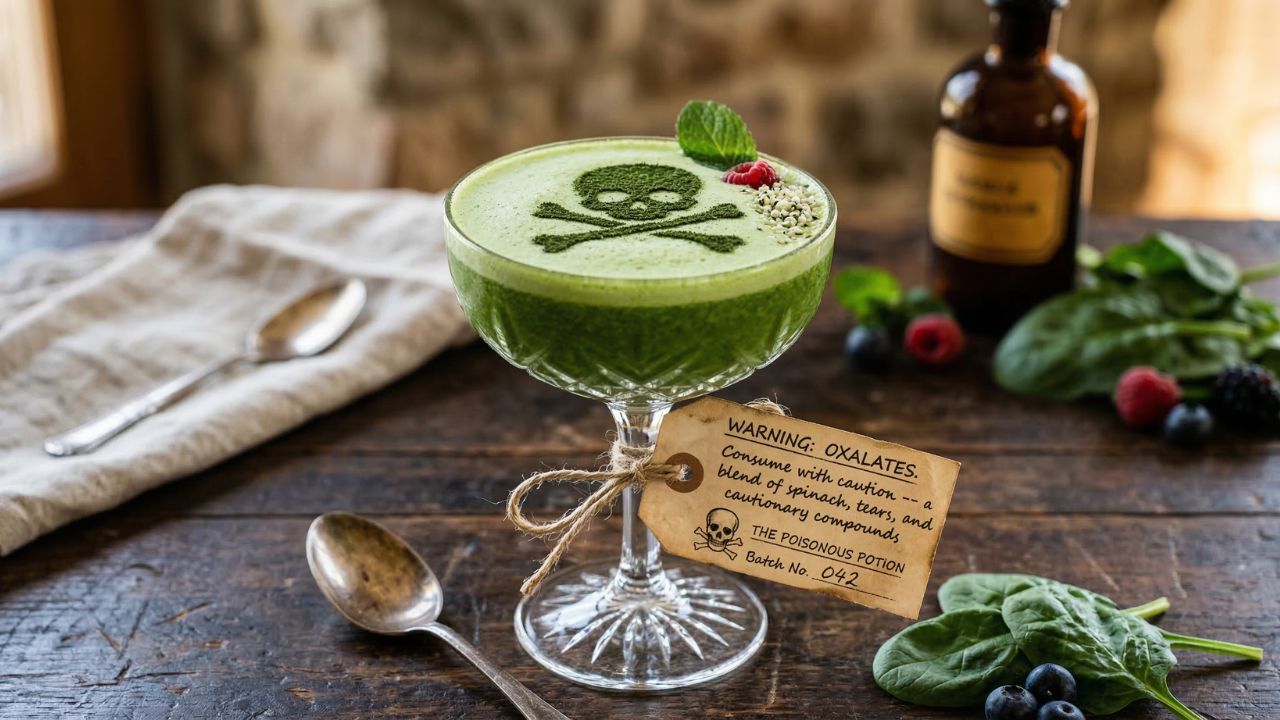
Read the companion piece: "The Wearing of the Green (Smoothie): Why Your 'Healthy' Greens Might Be Poisoning You"... how my "healthy" paleo diet accidentally led me straight into oxalate toxicity, and why your spinach smoothie might not be as virtuous as you think.
Your results are normal but you feel anything but? This explains why...and what to do about it
Frequently Asked Questions About Diet and Acne

Does diet actually cause acne?
Research increasingly supports dietary links to acne, despite decades of dermatologists saying otherwise. Common dietary triggers include dairy (particularly milk), chocolate, high-glycaemic foods, sugar, gluten, and processed seed oils. Individual triggers vary... what causes acne in one person may not affect another. The 1916 research by Schwartz, Heimann, and Mahnken found associations between blood sugar and acne over a century ago, and more recent research continues to challenge the old orthodoxy.
Can giving up chocolate clear acne?
It can for some people. Chocolate (particularly milk chocolate) contains dairy, oxalates, nickel, salicylates, often lead, cadmium, and sugar, several of which are linked to acne and all of which are linked with inflammation and mitochondrial dysfunction. Dark chocolate (high cacao) may be less problematic for some, though it's also high in oxalates, which brings its own issues.
Why do doctors say diet doesn't affect acne?
This became medical orthodoxy in the mid-20th century based on flawed studies. The 1916 researchers had correctly measured elevated blood sugar in acne patients, but later researchers tested the wrong mechanism (feeding people pure dextrose and watching for acne). When that didn't pan out, they concluded the diet-acne link was debunked. That flawed reasoning was repeated uncritically from textbook to textbook for the next century. More recent research has challenged this position, but medical education is slow to update.
Is dairy linked to acne?
Multiple studies have found associations between dairy consumption (particularly milk, but the reason is probably not what you think it is) and acne. The mechanism likely involves insulin-like growth factor 1 (IGF-1) and hormonal pathways. Fermented dairy (yoghurt, cheese) may be less problematic than liquid milk for some people.
What medications are commonly prescribed for acne and what are the side effects?
Common prescriptions include topical and oral antibiotics (gut microbiome disruption, nausea, antibiotic resistance), oral contraceptives like Dianette (weight gain, mood changes, blood clot risk), benzoyl peroxide (skin irritation, dryness), and isotretinoin/Roaccutane (severe dryness, liver stress, birth defects if pregnant, depression risk). Many people cycle through multiple medications over years before considering dietary approaches.
How long after a dietary change would you see skin improvement?
Many sources suggest 3-4 weeks of elimination is sufficient, but in practice, a minimum of 6-12 weeks gives a much clearer picture. Some triggers only become obvious with longer elimination periods (this was the case with chocolate and Lent... shorter breaks never revealed the connection). A flare after reintroduction is usually visible within 1-5 days, which is why the provocation part of elimination-provocation testing is just as important as the elimination itself.
Could my acne be related to gut health?
Very likely. The gut-skin axis is increasingly well-documented. Gut dysbiosis, intestinal permeability ("leaky gut"), SIBO, and microbiome disruption (often from antibiotic use... including antibiotics prescribed for acne) can all contribute to skin inflammation.
If I cleared my acne with diet, do I need to avoid trigger foods forever?
Not necessarily. Some people find that once gut health improves and overall inflammation reduces, they can tolerate many former triggers in moderation. Others find certain foods are permanent triggers. It depends on the individual and the underlying mechanisms involved.
What is evolutionary mismatch and how does it relate to acne?
Evolutionary mismatch describes the gap between what our ancient biology was designed for and how modern life forces us to live. The Kitavan Islanders of Papua New Guinea, eating a traditional diet of fish, coconuts, tubers, and fruit, have virtually no acne at all. Neither do other populations eating traditional diets. It's only when modern processed foods, refined grains, industrial dairy, plastic packaging, and other toxicants enter the picture that acne appears. Our bodies evolved over millions of years with specific dietary patterns. Modern processed foods create a mismatch that manifests as chronic inflammation... and acne is one of the visible signals.
How do I know if my symptoms are diet-related?
Elimination-provocation testing is the gold standard. Remove a suspected food completely for a minimum of 6-12 weeks, then reintroduce it and observe. Your body's response is the most reliable diagnostic tool you have. Keeping a food-symptom diary helps identify patterns that aren't immediately obvious.
About Dr Catriona Walsh: Catriona is a nutrition and lifestyle coach with a medical background who specialises in the conditions conventional medicine can't (or won't) explain. She works with clients through The Food Phoenix, helping the medically homeless find their way back to health. If you've been told "it's not your diet" and you don't believe them, you might be right.
The sequel is already out there. After Lent cleared my skin, I went paleo. The high-vegetable, green-smoothie, almonds-and-spinach version that everyone was doing at the time. I thought I'd cracked it.
I hadn't. I'd just traded one set of problems for another.
If you want to know what happened next (oxalates, crystals accumulating in tissue, and why my "healthy" eating plan was quietly making me worse)... that story is here.
References
Schwartz HJ, Heimann WJ, Mahnken HC. The Sugar Content of the Blood in Various Diseases of the Skin. Journal of Cutaneous Diseases Including Syphilis, 1916; 34(3):159-165. Available via Internet Archive
Cordain L, Lindeberg S, Hurtado M, Hill K, Eaton SB, Brand-Miller J. Acne Vulgaris: A Disease of Western Civilization. Archives of Dermatology, 2002; 138(12):1584-1590. doi:10.1001/archderm.138.12.1584. JAMA Dermatology
Lindeberg S, Berntorp E, Nilsson-Ehle P, Terént A, Vessby B. Age relations of cardiovascular risk factors in a traditional Melanesian society: the Kitava Study. American Journal of Clinical Nutrition, 1997; 66(4):845-852. doi:10.1093/ajcn/66.4.845. AJCN
Juhl CR, Bergholdt HKM, Miller IM, Jemec GBE, Kanters JK, Ellervik C. Dairy Intake and Acne Vulgaris: A Systematic Review and Meta-Analysis of 78,529 Children, Adolescents, and Young Adults. Nutrients, 2018; 10(8):1049. doi:10.3390/nu10081049. PMCID: PMC6115795.
Sánchez A, Sánchez K, Johnson L. Minocycline-Induced Dental Pigmentation. Journal of Pharmacy Practice, 2015; 28(3):288-292. PMC
Co-cyprindiol (Dianette) 2000/35 microgram coated tablets. Patient Information Leaflet. Medicines.org.uk