
I Read the Gadolinium Safety Studies As If They Were Comic Books
It was the only honest way to read them.
If you have had an MRI "with contrast," you were almost certainly given gadolinium: a toxic heavy metal, wrapped in a molecule designed to hold onto it until your body can flush it out. Most of it usually does leave. Some of it, we now know, stays, in the brain, the bones, the skin.
For decades, nobody had properly tested what that metal does to the developing bodies of babies, children, or the unborn. So a regulator finally insisted. The result was three animal safety studies, run long after the dye was already in worldwide use, by laboratories paid by the companies that make it.
I have spent months reading those three studies. And the only way I can describe the experience honestly is this: they read less like science and more like a comic-book trilogy in which the hero is a pharmaceutical company, the plot makes no sense, and nobody wants to talk about the bodies. So that is how I am going to review them. The jokes are mine. Every fact underneath them is theirs, taken straight from their own published pages. There is a plain list of those facts at the end, so you can check every one.
Volume one: the super-mice
The first book doses baby mice daily with the metal and then tests their grip strength.
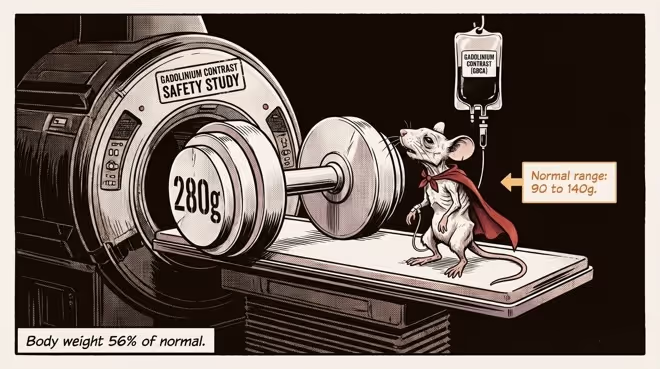
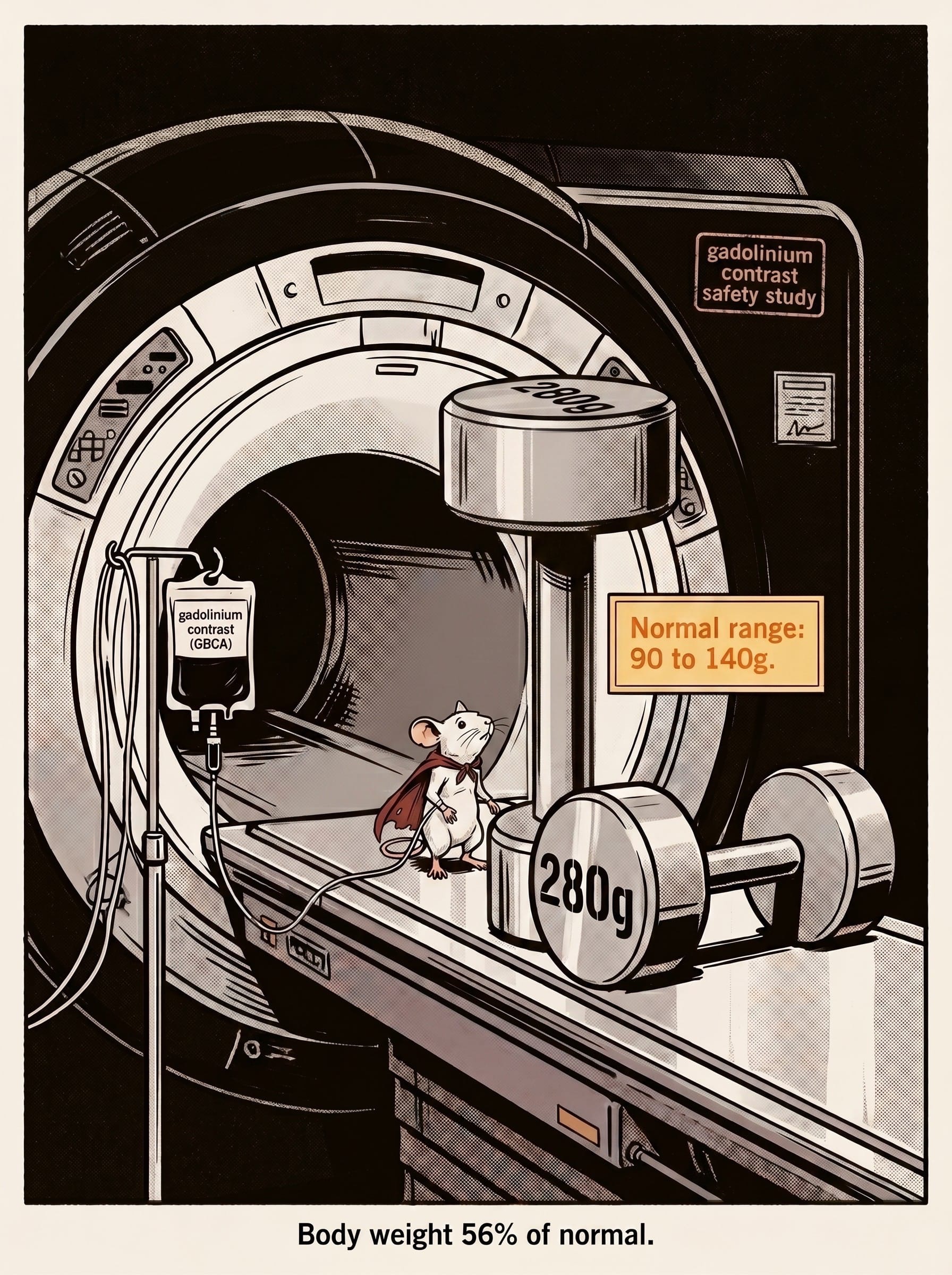
And the mice come out strong. Not a bit strong. The numbers reported are roughly double the normal published range for healthy mice their age, in animals that the same study describes, a few pages earlier, as underweight runts growing at little more than half the normal rate.
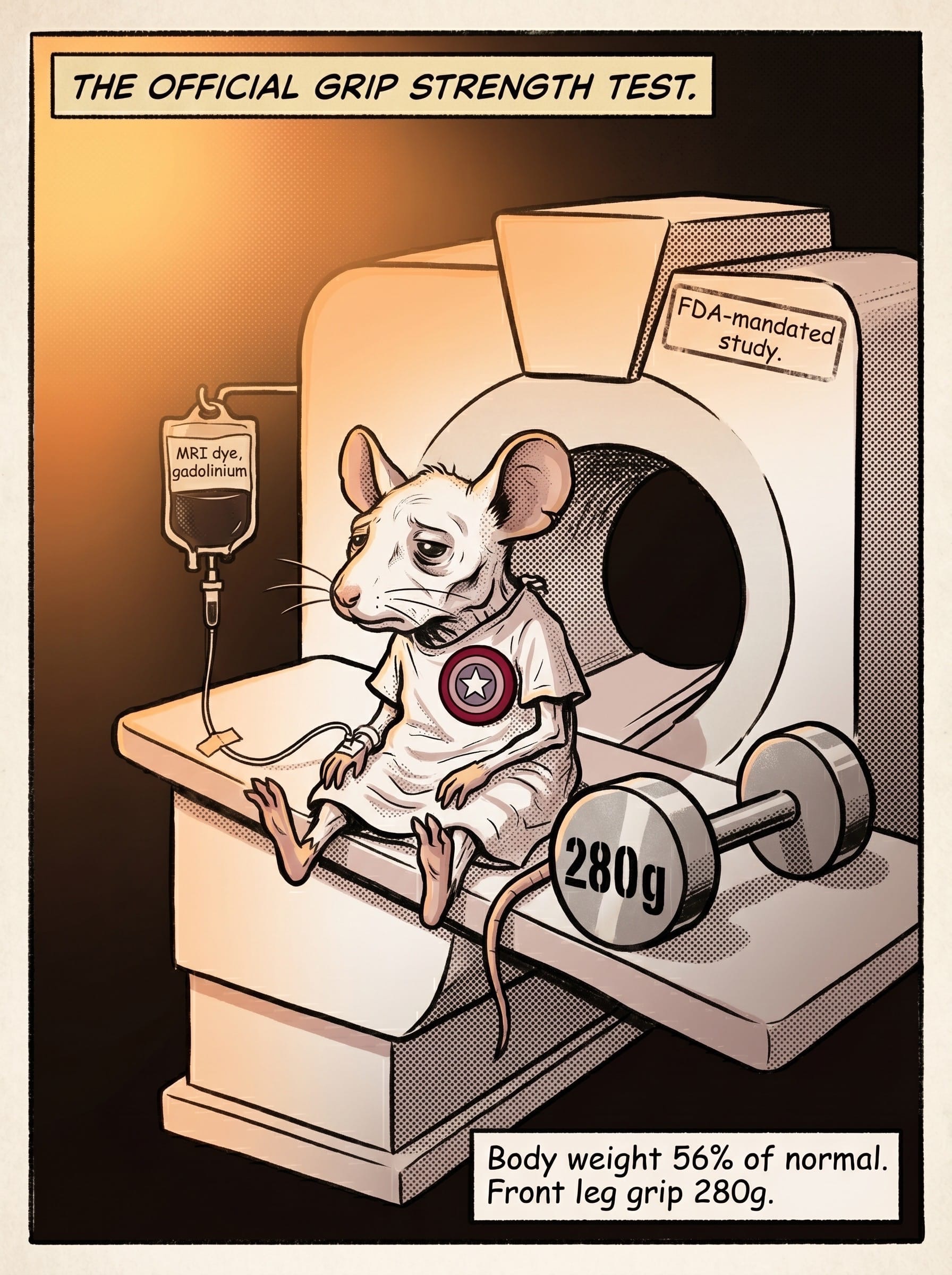
So: sick, scrawny, half-grown baby mice, with the proportional grip of a small monkey. I kept waiting for the radioactive spider. There isn't one. We are simply expected to accept that the most damaged animals in the experiment were also the strongest, and to turn the page.
Here is the giveaway, though. It is the front leg numbers that sail clean past anything biology allows: 270 to 280 grams against a published range of about 90 to 140 grams for mice this age. (The back legs are over-egged too, but there is no tidy published figure to catch them against, so the front legs are where the impossibility is unanswerable.) And in a second study, run in the same lab, the front-leg figures for those same drugs dropped by a third to a half, back toward reality, while the drugs that had looked normal barely moved. Which means the mice were never strong at all. Somebody was just holding them differently, in a way that pushed the number up. The superpower was not in the mouse. It was in the hand of whoever ran the test, and in a conclusion that needed the figure to come out high.
There is a name for what these mice are, and it is not Hulk. They are Schrödinger's mice. Their strength sits in a superposition of "superpowered" and "perfectly ordinary" right up until the moment a measurer opens the box, at which point it collapses into whatever number the study needed that day. We know this because the powers do not survive a second look: when a different person measured a fresh batch in the follow-up study, the impossible drugs' figures fell by a third to a half, and the effect showed up even in the salt-water mice who were never given anything. Powers that vanish the moment someone else holds the stopwatch were never powers.
They were a number that knew what it was supposed to say.
Volume two: the mothers
This is where it stops being funny.
The super-mice are the ones who lived. In the study on pregnant mothers, one reported figure is that 13 of 88 gadodiamide mothers produced no surviving offspring at all: found dead, unable to carry a pregnancy, or losing the whole litter. That is roughly one in seven, pooled across all doses and worse at the highest, against the laboratory's own background rate of about six to eight per hundred. But the worse number hides in a quieter sentence. Every group, they note, had "more than 15 pregnancies", from starting groups of 22 to 26 mothers. Whatever "more than 15" means exactly, the arithmetic is unforgiving: even on the most generous reading, that leaves at least 6 of the 22 to 26 mothers, and as many as 10, producing nothing usable. More than a quarter. Possibly a third. And that single phrase swallows everything it does not name: the mothers who could not conceive, who resorbed or aborted, who died, who cannibalised their own litters, the pups born dead or dying or malformed. The paper's own words, "found dead", confirm some mothers simply died, but it never gives a clean count, and the animals that died were never opened up at all. The studies describe what little they do report in prose so clinical it reaches actual sterility, a fitting register for a body of work about the sterilising and killing of mothers at this rate.
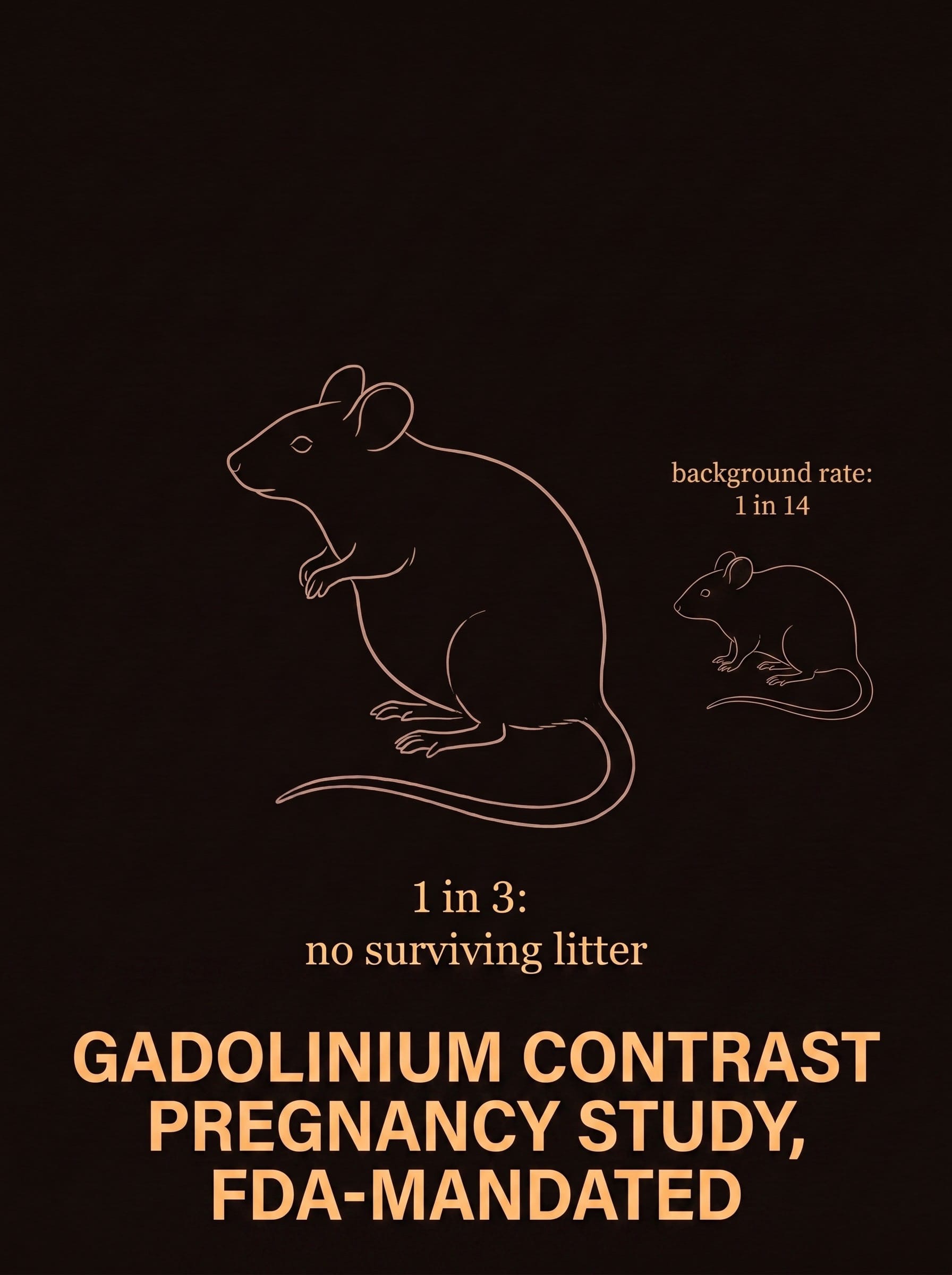
How do we know the researchers saw this coming? Because partway through, they started planning for it. The first drugs got no spare mothers. Then, for the remaining high-dose groups, four extra mothers each quietly appeared in the design, enough to absorb the losses they were now expecting and keep the body count from showing through the data. For one drug, even four was not enough.
And then, in the flat language these documents are written in, they recorded the dose that did this as having no observable adverse effect.
Between one in four and one in three mothers, in the worst group, losing everything. No observable adverse effect.
So the strength of the survivors in volume one curdles into something sadder. These are not superheroes. They are the ones who happened to live through an experiment in which more than a quarter of the would-be mothers in their nursery lost everything, some of them their own lives, along with an unknown number of the pups who should have been their littermates. If Deadpool were a mouse, scarred and unkillable and joking through a trauma nobody will name, he would fit right in. Except Deadpool got an origin story. These mice got a footnote.
Volume three: the monkey and the impossible exam
The last book swaps mice for baby monkeys and adds a memory test.
.jpg)
Now, the same researchers had already published a study showing that the exact memory test they chose does not work in these monkeys. The animals cannot remember that far back. They score no better than a coin toss. Knowing this, the researchers ran the test anyway, watched the monkeys fail exactly as their own earlier work predicted, blamed the monkeys, and wrote it up as evidence of no memory problem. Who knows whether they chose a test they knew would be failed quietly? I only know that they had every reason to expect the blank papers, and counted them as a good result. It is like setting an exam in a language you know the students do not speak, then pointing at the empty scripts as proof they had nothing to say.
They also ran a second memory test, one that might actually have worked. Its results never appear in the paper. The data was collected. There is simply no column for it.
And the main test rested on just eight monkeys per group by the point that counted. In the worst group, six of those eight failed a cognitive test that three-quarters of the healthy monkeys passed. A drop that large, in human terms, means harm in nearly every animal exposed. The study's verdict? Not statistically significant, because eight animals is too few to prove anything. And there is the trick, the one that runs through all three books: too few to prove harm is also too few to disprove it, and the benefit of that doubt always, always falls the same way.
If you feel unwell after a contrast scan, and no one believes you
Here is the part I most want you to read, and it is not a joke.
Maybe a small voice told you not to have the contrast. Maybe you said yes anyway, because the doctor was worried, or because you were, and saying no felt impossible in that moment. Maybe the scan came back clear and the dye told them nothing they needed. And maybe, weeks or months later, you started to feel wrong in ways you could not explain, and when you went back, the same medical practitioner who talked you into the injection now told you it could not possibly be that.
If this has happened to you, you're not alone. A small group of patient advocates, including me, collected reports from 324 patients who experienced a decline in their health after gadolinium contrast scans. 316 of us had normal or near-normal kidney function, but you'd probably be shocked by how much our symptoms overlapped with those of NSF. You can read the full survey results in the detailed report, which is available for download here. But if medical reports aren't your thing, you can also read my article on some of the main report findings here. If you do decide to download the report, I'll also send you a plain-English explanation of the main findings. All of this is free, in case you're wondering.
If you have been carrying the thought "I knew something was wrong, but I let them talk me into it," I need you to hear this clearly: you did not do this to yourself. You trusted a recommendation that was backed, you were told, by safety studies. This piece is about what those safety studies actually contain.
And what they contain is not proof of safety. None of these studies show that the dye is safe. They were never built to. They were built to be reassuring enough to skim. A reassuring skim is all it takes, because the doctor who ordered your scan, and the one who later told you your symptoms were anxiety, has almost certainly read the conclusion and not the data. They are not lying to you. They are passing on a summary that was written to soothe, in good faith, never having seen the numbers underneath it.
That is why so many people who feel unwell after a contrast scan are told it cannot be the dye. Not because anyone checked your case against real evidence and ruled it out, but because a document exists that says "no observable adverse effect," and that document is treated as outranking your own account of your own body. Your labs come back normal because the labs are not measuring the thing that is wrong. Then the normal labs and the reassuring document become the proof that it is all in your head.
It is not all in your head. If you have lived this, you are not imagining it, you did not bring it on yourself by being weak or anxious, and you are very much not alone. The studies meant to protect you could not have detected what you are experiencing even if it were happening to most of the animals they tested, because they were too small, too short, and too cleverly framed to see it.
I know this terrain because I have walked it. If you want the plain, non-satirical version of what is and is not known about gadolinium, start with my From Darkness to Light: A Personal Journey of Gadolinium Toxicity Recovery. If you want the whole story of how we got here, and a framework that finally makes the chaos make sense, that is what my book Contrasts: More than meets the MRI is for.
The facts behind the jokes
Every joke above stands on a published number. Here they are, plainly:
The "super-mice": front-leg grip strength of 270 to 280 grams was reported in mice whose published norm is about 90 to 140 grams at this age, in animals that weighed around 30 grams and were growing at 56% of the normal rate. (The back-leg figures are also too high but lack as clean a published comparator, so the front leg is where the impossibility is unanswerable.) In a second study in the same lab, those same drugs' front-leg figures fell by a third to a half, back toward reality, while drugs that had looked normal barely moved, which points to a measurement problem, not real strength. The same drugs landed in the same strength order across both studies far more consistently than chance allows (a concordance score of 0.84, with odds against coincidence below 1 in 10,000), the fingerprint of who ran the test rather than of biology.
The mothers: two figures matter. (1) 13 of 88 gadodiamide mothers (~15%, pooled across doses, worse at the top dose) produced no surviving offspring, described as "found dead, aborted, or euthanised due to no surviving pups", against the lab's own ~6 to 8% background for such failure. (2) More tellingly, the paper states every group had "more than 15 pregnancies" from starting groups of 22 to 26. Whatever the exact meaning, even the most generous reading leaves at least 6 (and up to 10) of the 22 to 26 mothers producing nothing usable: more than a quarter, possibly a third. That single phrase absorbs conception failure, resorption, abortion, maternal death, cannibalism, and pup death, none of it broken out. Some mothers genuinely died ("found dead") but no separate death count is given, and animals that died were not necropsied. Spare mothers were added to most high-dose groups; for one drug even that was not enough. All reported as no adverse effect at the highest dose.
The memory test: the regulator specifically required memory to be assessed. The long-term test used had been shown, by the authors' own earlier study, to be meaningless in this species. A second, short-term memory test was run and its results were left out of the paper.
The cognitive collapse: in the worst monkey group, 2 of 8 passed a learning test that 6 of 8 controls passed, a fifty-point drop reported as "not statistically significant." The study had only about a 40% chance of detecting a gap that size even if it were real, and for one of the agents that chance was around 3%.
These are not exaggerations for effect. If anything the comic framing is kinder than the data deserves. The numbers come from the manufacturers' own studies; the analysis is mine and my co-authors', and the full working is available.
The 3 FDA-mandated safety studies in question
1. Smieja D, Czupalla O, Günther C, Bussi S, Coppo A, Jones P, Forni M, Fretellier N, Bourrinet P, Luetjens CM. Evaluation of Gadolinium-Based Contrast Agents in Juvenile Non-Human Primates Including Behavioral Evaluations Such as Learning and Memory. Birth Defects Res 2025; 117(4): e2470.
2. Lewis EM, Jones P, Clemens G, Fretellier N, Bussi S, Hirani E, Czupalla O, Tedoldi F, Bourrinet P, Hoberman AM. Evaluation of gadolinium-based contrast agents in juvenile CD-1 mice including behavioral evaluations. Birth Defects Res 2024; 116(1): e2284.
3. Lewis EM, Bussi S, Fretellier N, Clemens G, Jones P, Tedoldi F, Bourrinet P, Czupalla O, Hirani E, Hoberman AM. Evaluation of gadolinium-based contrast agents in pregnant CD-1 mice and subsequent in utero exposure of the developing offspring, including behavioral evaluations. Birth Defects Res 2024; 116(1): e2291.
Dr Catriona L. Walsh is the author of Contrasts: More than meets the MRI and writes about gadolinium contrast safety at The Food Phoenix.