A new deadly superbug fungus has come to town
A new, deadly, antimicrobial-resistant superbug fungus has emerged in multiple countries simultaneously over the past couple of decades. The first report of the deadly superbug fungus, Candida auris, was published in 2009. It was isolated from a person’s ear. Now it’s responsible for infectious outbreaks that can close intensive care wards, and the World Health Organization has listed it as a critical-priority fungal pathogen.
Since the first report in 2009, cases have surged. US cases went from 2,882 in 2022, to 4,428 in 2023, and 6,197 in 2024. During 2022–2024, a total of 27,853 screening cases were reported to CDC.
For many patients who are infected with it there is no known cure. It possesses a nasty combination of virulence, persistence and resistance to multiple antifungal drugs. Conventional antifungals often don’t even tickle it. Over 90% of isolates from some clades are now fluconazole-resistant, about 6-46% are resistant to amphotericin B, and roughly 5% are resistant to the echinocandins, which are the fallback.
Many people carry it. If you’re immunosuppressed and ill, you may have a 30% to 67% risk of dying if this particular fungus is cultured from you. It’s colonising elderly care homes and neonatal units as well as hospitals. It’s also in our communities. It makes MRSA look like child’s play, and it is on the rise.
Why has this new deadly superbug fungus only suddenly appeared in the last couple of decades?
Why is this fungus popping up out of nowhere? We don’t know, but it is highly suspect that it is somehow related to some thing or things that we’re doing to our environments.
Is it the indiscriminate and excessive use of fungicides, herbicides and pesticides on conventional crops that’s allowing this deadly superbug to thrive?
We are killing most of the soil microbes through industrial agriculture. When farmers use excessive industrial fertilisers they can massively alter the soil microbiome. Only the truly resistant bugs will have a chance to survive our environmental apocalypse.
Is it to do with our excessive use of antibiotics and hand sanitisers?
We already overuse antibiotics in humans, but even worse is the overuse of antibiotics in factory animal farming. The demand for cheap boneless, skinless chicken breasts and cheap eggs permits awful, inhumane factory farms. These pump animals full of antibiotics and concentrated animal feeds full of herbicides, pesticides and fungicides. Then they release the toxic effluent into the environment.
Our war against microbes in 2020 didn't stop with antibiotics. 2020 and 2021 were the years of the hand sanitisers. We applied them with gay abandon and no consideration of what impact they'd have on our resident skin microbiome. When you strip away the beneficial microbes, it creates a vacuum. What were we expecting to take their place? Gumdrops and lollipops? It seems that the legacy of the pandemic response may be harder to count than anticipated. Not that anyone's actually counting.
An observation that I find fascinating is that antibiotic prescriptions in the community plummeted in the UK in 2020 and hadn't recovered to baseline figures four years later.
On the other hand, patients admitted to hospital during the same time frame were often admitted with severe infections that had progressed further than usual, resulting in more prolonged courses of stronger antibiotics.
Ask me how I know.
Ok. I'll tell you. In 2023, my wonderful dad was admitted to hospital, more than half dead, following aspiration pneumonia when his swallow mysteriously disappeared completely. The cultures grew an unusual bug, Klebsiella, rather than a fungus. But he received 6 weeks of intravenous meropenem, which contributed to liver and kidney damage. During his admission, his awesome respiratory consultant confided that they'd been seeing lots of bullous empyema since the pandemic because people had been staying at home, as directed, and presenting with severe infections at a late stage. They saw this so often that they presented it. Doctors around the world have reported similar findings, with late presentation resulting in significantly higher mortality rates in non-COVID illnesses.
This paper on pleural empyema in Hong Kong described dramatic changes in the presentation of pus-filled fluid in the chest, which contained multiple microbial species. Complicated infections involving multiple organisms often require complex, prolonged antimicrobial regimens. They also found an increase in cases of empyema among those over 60 years old during the 2.5 years from January 2020 to June 2022, compared with the five years from 2015 to 2019. Fascinatingly, empyemas almost disappeared in kids over the same time frame.
German doctors described a significant fall in surgically treated pleural empyema in 2020 and 2021, and they discussed how delayed presentation during the peak years of containment could explain why they also saw a shift to more advanced stages requiring significantly longer operating times, prolonged postoperative chest tube drainage, and an extended length of hospital stays.
For every patient who couldn't be assessed in a timely manner yet fortunate enough to survive long enough to even manage to present with their complicated pneumonias, who knows how many others died at home from preventable infections because of the barriers to being properly assessed?
Could it be something to do with the indiscriminate use of statins?
Statins are now widely recognised to have antimicrobial, but especially antifungal, activities. Statins alter our gut microbiomes. In addition, they are also being found in the water, since they are passed out largely unaltered into our sewage. Their antimicrobial activities continue even after they’ve been through the sewerage systems. This is often the same water we use to irrigate our crops. Our drinking water is contaminated with a dazzling array of medications, not just statins.
How about the use of antimicrobial artificial sweeteners and preservatives?
Preservatives, artificial sweeteners and other food additives are increasingly added to our terrible ultra-processed and processed junk food diets. Junk foods can often sit on a shelf for months or years without decomposing. What are those things doing to our microbiomes, and also our environments?
Governments and the food industry are actively pushing nutrient poor junk food on consumers. They’re doing this in the guise that they are healthy, sustainable and environmentally friendly. But they’re anything but!
As well as this, we’ve reached the stage where few of us even recognise when a food is ultra-processed junk. Sure, everyone can recognise that a MacDonald’s is ultra-processed. But what about the new Impossible Burger? It boasts an impossibly long list of food extracts, industrial seed oils, and isolated highly processed ingredients. But it’s very short on anything that you could call a whole, unprocessed, real food. Unless you count the water and salt?
How about the impact of environmental pollution?
All those heavy metals, dioxins and products of the petrochemical and mining industries are also altering our ecosystems. They are not just toxic to our own mammalian cells, but to friendly microbes that surround us everywhere in our environment.
How about the use of other drugs, from antidepressants to gadolinium based contrast agents?
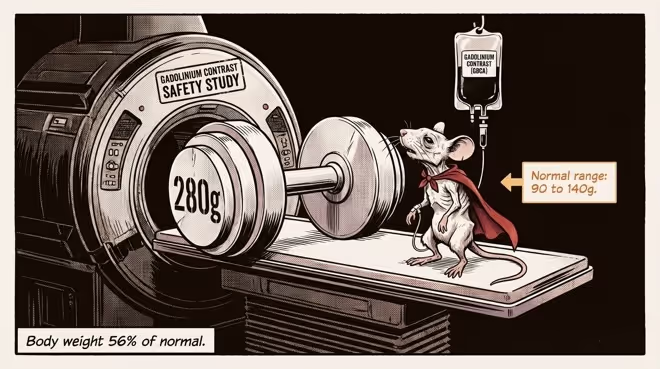
So many commonly used medications are incredibly toxic. And they don’t work very well. It’s a wonder why they’re allowed at all. At least you might wonder that until you read this article on the pharmaceutical cabal. One must wonder whether any commonly injected drugs known to impact the immune system might also have contributed to the sudden explosion in the wake of 2020 to 2021.
There is a consequence of messing up our microbial ecosystems
When we kill off some microbes, we must expect that other ones will step in to fill the void. “Nature abhors a vacuum” can apply to wiping out swathes of microbes as well. Human activities have already caused the spread of other multidrug resistant microbes.
While this is just the latest consequence in a long string of disastrous things we’ve been doing over the centuries to destroy our ecosystems, it certainly won’t be the last. Will we continue to shut our eyes and self-sabotage? What can we change to ensure that we don’t wipe ourselves off the planet through our own hubris?
What options are open to us to reduce the negative impact of our farming?
Plant-based diets are clearly not the answer to this problem. Nor are GMOs, industrial agriculture, or conventional dietary guidelines. Anyone who knows me, is one of my clients, or follows me will probably know where I stand on diet, medication usage, and the importance of trying to return more to nature in all areas of our lives.
As far as I can see, our greatest hope is to use regenerative agriculture to produce both animal products and crops. We should use inputs that are as natural as possible. Synthetic inputs need to go. And we need to do all this while rebuilding soil.
What is the role for dietary change?
We also need to completely overhaul our disastrous dietary guidelines. It’s long overdue. Only then will we be able to reverse the epidemics of metabolic syndrome, malnutrition, heart disease, cancer, osteoporosis, Alzheimer’s, depression, and other chronic diseases.
And does our approach to conventional medicine need to change?
Most people want to stay out of hospitals and off medications as much as possible. From a national perspective this should also really be a goal.
And while we’re talking about medications, we also need to consider the post-antibiotic era. It’ll be here far too soon. Phage therapies (finding viruses that very specifically target bacteria) could be an exciting strategy to replace antibiotics.
Finally, we need to train our doctors in functional medicine to get to the root cause of what is making people ill. Having drug companies training them to prescribe their medications to suppress specific symptoms isn’t working. Well, it’s working out great for the drug companies, who are reporting record profits, year on year. But it’s not working out quite as well for sick people.
We need to put some effort into making sure that everyone understands the microbiome. It’s important to know why it’s vital, and what harms and helps it.
How is the future looking?
What else can we do to turn around our trajectory towards annihilation?
Or do you feel that we are so overpopulated now that we need some calamities to reduce the human population anyway?