Your doctor said the contrast dye was safe. Your symptoms started afterwards. When you went back, you were told the two weren't connected. You're not imagining it, and you're not alone.
324 patients. 95% of their symptoms were neurological. 1 in 4 reported suicidal ideation. This is the pattern medicine still calls coincidence.
Inside, free:
• The largest patient-led survey on life after gadolinium contrast — their symptoms, timelines, and words
• Why "normal" kidneys don't mean you're safe, and what independent research actually shows
• The evidence to take to your doctor, printed and ready
Your doctor said the contrast dye was safe. Your symptoms started afterwards. And when you went back, you were told the two things weren't connected.
You are not imagining it. And you are not alone.
This report documents what 324 patients experienced after gadolinium-based MRI contrast agents — 316 with normal kidney function, 8 with nephrogenic systemic fibrosis. Their words. Their timelines. A pattern the medical establishment still officially calls coincidence.
It won't give you a diagnosis. What it will give you is a framework. A body of evidence. The beginning of an explanation that finally holds together.
The largest patient-led survey of its kind. Their voices are in this report.
Since gadolinium contrast was first approved as "completely safe" Thirty-seven years of patients being told the same thing.
Reported at least one functional disability Not a mild side effect. A life interrupted.
Reported suicidal ideation One in four — at a rate 2–5 times higher than the general population, and in a pattern that correlates with contrast administration and subsequent medical dismissal, not pre-existing psychiatric history.
If you are struggling, the Samaritans are available 24/7: call or text 116 123 (UK and Ireland, free).
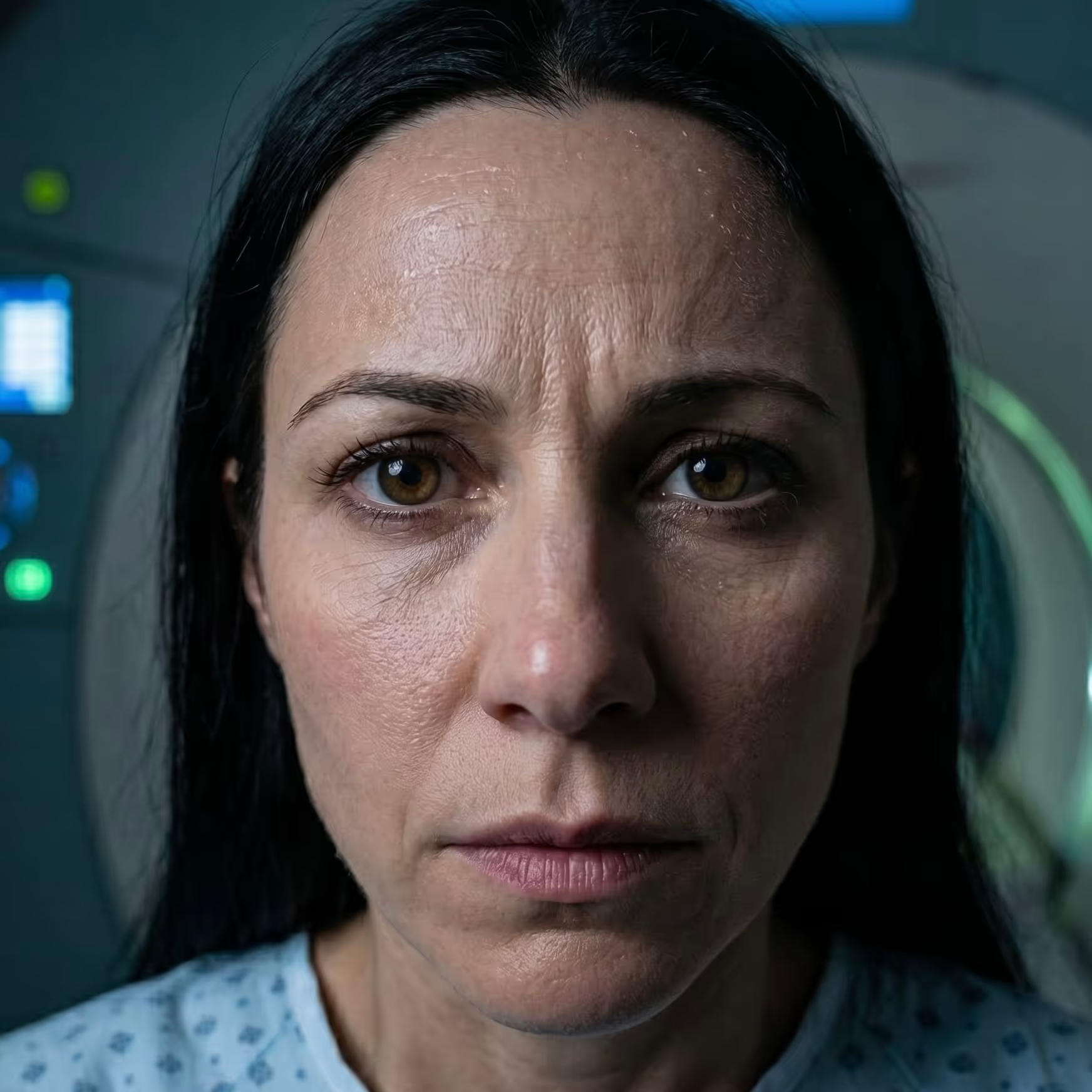
If you had an MRI with contrast and then everything changed — your brain got foggy, your body ached in ways no one could explain, and every test came back "normal." You were told it was stress. Or anxiety. Or something you needed to manage better. The scan was months or years ago, but something has never quite been right since.
This report names what happened.

If you're the person standing next to someone you love — watching them decline after a routine scan, having to listen while doctors list every psychiatric reason why the contrast dye can't possibly be responsible. You came here because you know something doesn't add up.
This report gives you the evidence for a different conversation.

If you're a researcher or clinician who's seen the pattern — patients presenting with symptoms that don't fit the standard narratives, timelines that keep pointing back to contrast exposure, and a safety profile that doesn't match what you were taught. Your training never covered this. The data did.
This report is where the evidence starts.

If you're a journalist or advocate working on medical harm, patient safety, or regulatory failure — this is a primary source. The full methodology is available for scrutiny. The data doesn't ask you to take anything on faith.
This report exists to be put in front of people who need to see it.
Data from 324 patients (316 with normal kidney function, 8 with NSF): the symptoms they reported, how long they lasted, and how they changed over time
The most commonly reported symptoms, from cognitive changes and chronic pain to immune disruption and fatigue that sleep doesn't fix
What independent research says about gadolinium retention in people whose kidneys were working perfectly, and why that matters
Why so many patients are dismissed, and the specific patterns in this data that clinicians and regulators have not yet adequately explained
Resources for patients, carers, clinicians, and researchers, including support communities and further reading
Advanced statistical data for researchers: Fisher's exact test results and symptom heatmaps (NSF, GDD, and survey data)

"You'll pee it all out within 48 hours."
Your doctor probably believes this. It was never based on a study that showed complete elimination in any patient. It was a claim: confidently made, widely repeated, and passed on in good faith by clinicians who had no reason to question it.
Court documents from NSF litigation tell a different story. The drug companies knew gadolinium was not fully eliminated. The FDA knows. And biopsy evidence confirms it: gadolinium has been found in bone 14 years after a single scan. In colon tissue, 13.6 years later. In nails, 15.8 years after one exposure.
There was never a study showing complete elimination. There was only a claim. And the claim travelled further than the evidence ever could.
In 2015, the FDA confirmed what patients had been saying for years: gadolinium from MRI contrast agents is retained in the body, including in the brains of people with perfectly healthy kidneys. The official response was to add a warning to the label.
That was over a decade ago. The patients kept getting sick.
This survey, the largest of its kind, features 316 participants with normal kidney function and documents a 37-year symptom timeline and 12 distinct safety signals that warrant urgent further investigation. It does not prove causation. It does something arguably more important: it makes the pattern impossible to dismiss.
For clinicians watching this: you are right to be sceptical. Gadolinium-based contrast agents are essential diagnostic tools. Nobody is asking you to stop using them. We are asking you to look at the toxicological pattern that your own regulatory bodies have already acknowledged, and to take seriously what your patients are telling you.
You've waited long enough for someone to take this seriously. The data is here.
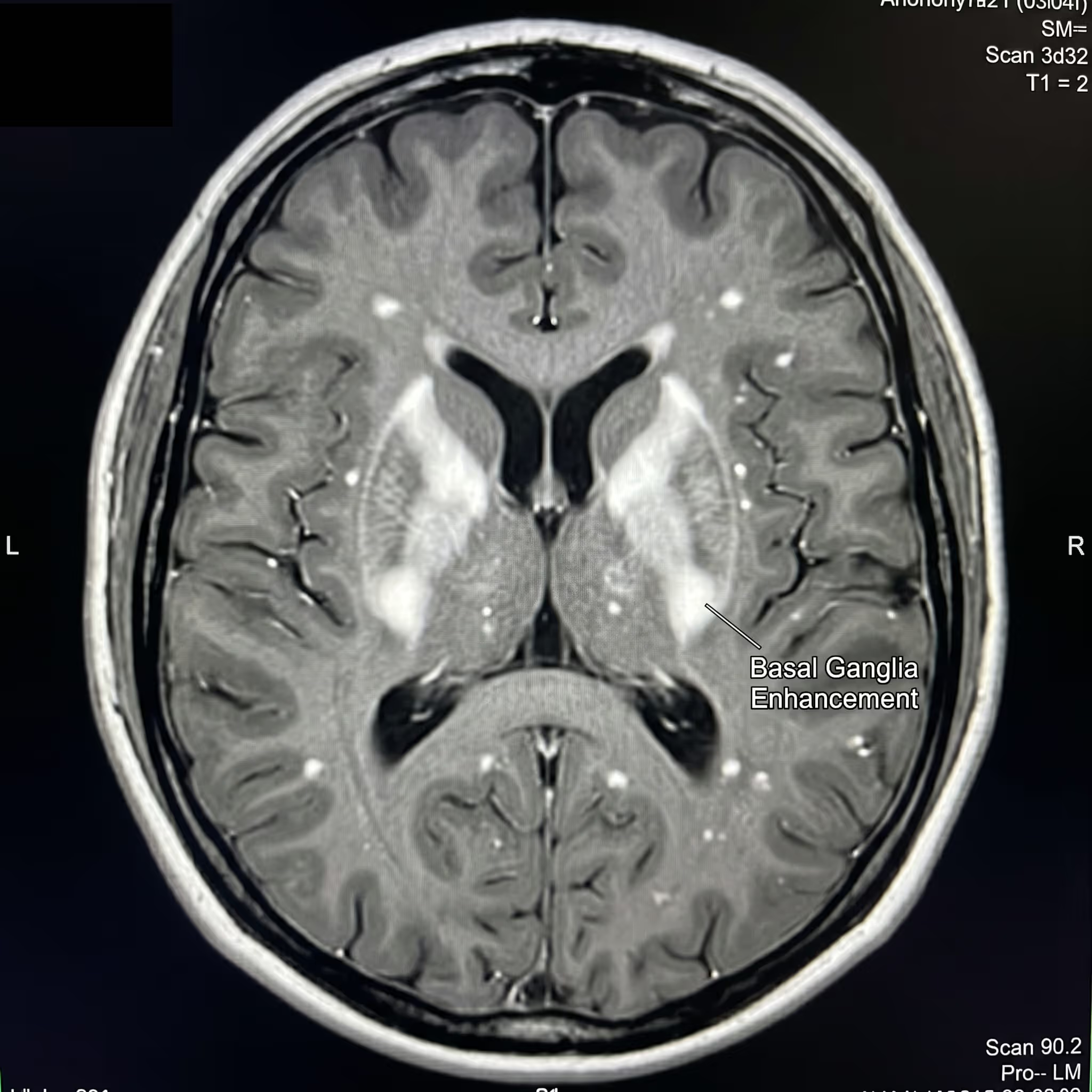
Brain fog. Cognitive impairment. The creeping sense that your mind is no longer yours.
Not imagined. Not anxiety. Neurological.
The report includes supplementary statistical data for those who want to go deeper.
Alongside the main findings, you'll receive access to the full Fisher's exact test results (with Benjamini–Hochberg false discovery rate control) comparing linear versus macrocyclic gadolinium-based contrast agents, and a symptom overlap heatmap drawing on NSF, GDD, and survey data.
The methodology and limitations are documented in full. This data is hypothesis-generating, not conclusive. We welcome scrutiny.
Reviewing this for clinical or research purposes? Download the report and access the full methodology →
Enter your name and email to receive the full report: the patient data, the statistical analysis, the expert commentary, and the supplementary research materials. Immediately. Free. No paywall.
You'll also receive occasional updates from The Food Phoenix on gadolinium toxicity, MRI contrast safety, and nutritional approaches to recovery. You can unsubscribe at any time.
Get the full survey findings, the statistical analysis, and the supplementary data. Free. No paywall.
Connect with others navigating the same experience. Get updates when new research emerges. Know you're not searching alone.
Print it. Email it. Bring it to your appointment. This report was built to be put in front of the people who need to see it.
No. It was built by and for patients, but the data is relevant to anyone trying to understand what happens to gadolinium after it enters the body. Clinicians have found it useful when a patient presents with unexplained post-MRI symptoms. Researchers have cited the methodology. Journalists have used it as a starting point for investigation.
Yes. Your email is used to send you the report and occasional updates from The Food Phoenix. It is never sold, shared with third parties, or used for anything other than what you consented to. You can unsubscribe at any time, and your data will be deleted on request in line with GDPR.
Anyone who has had an MRI with gadolinium contrast and is experiencing symptoms their doctors cannot explain. Anyone supporting a patient in that situation. Any clinician, researcher, or journalist who wants the patient-reported data rather than the manufacturer's summary of it.
The full findings from the largest patient-led survey on post-gadolinium symptoms in people with normal kidney function. That includes the 12 safety signals identified, the 37-year symptom timeline, symptom frequency and severity data, patient-reported life impact, and the supplementary statistical analysis. Expert commentary contextualises the findings against the existing scientific literature.
No. This is a patient-led research document. It shares observed patterns from survey participants and places them in the context of existing scientific evidence. It does not diagnose, prescribe, or recommend treatment. If you believe you are experiencing symptoms related to gadolinium contrast, please speak with a qualified healthcare professional and bring this report with you.
Yes. It won't replace a clinical diagnosis, but it will give you language, evidence, and a documented symptom pattern that you can take to your doctor and actually be heard. Many patients have found that bringing this report to an appointment changed the conversation entirely.
The survey was designed and administered by patients and advocates, with methodology reviewed for rigour. Participants included 316 individuals with normal kidney function and 8 with nephrogenic systemic fibrosis. Data collection prioritised anonymity. No personally identifiable information was gathered. The methodology, limitations, and statistical approach are documented in full within the report.
Please do. That is exactly what it's for. The report is freely available and may be shared in full. If you'd like to share a printed copy, you can download and print it directly from the link in your confirmation email.
Document your symptoms, including when they started relative to your MRI date. Bring that record to your GP or specialist alongside this report. If you would like to talk through what you're experiencing and explore whether a nutritional approach might support your recovery, you can book a free Comprehensive Health Assessment with Dr Catriona Walsh at thefoodphoenix.com.
Yes. Join the mailing list to hear about future research opportunities. If you would like to share your experience for advocacy or research purposes, you can get in touch via thefoodphoenix.com.
No. It doesn't claim to. This is observational, patient-reported data: hypothesis-generating, not conclusive. What it does is document a pattern that is statistically significant, temporally consistent, and biologically plausible. A pattern that meets several of the Bradford Hill Criteria for causation. The report contributes to a growing body of evidence that deserves formal investigation. Whether the medical and regulatory establishment chooses to take it seriously is, at this point, a question of political will as much as science.
Online patient communities exist specifically for gadolinium toxicity and gadolinium deposition disease. Search for GDD support groups on Facebook and patient advocacy forums. Catriona's book, Contrasts: More Than Meets the MRI, covers the science and the personal experience of navigating gadolinium toxicity. And The Food Phoenix offers nutritional and lifestyle coaching for people working to recover from gadolinium-related illness.
Book a free Comprehensive Health Assessment at thefoodphoenix.com. This is a one-to-one video consultation with Dr Catriona Walsh. Not a sales call. A proper conversation about what you're experiencing and whether nutritional coaching could help. There is no obligation.
↓ Still have questions? The report answers them. Get it free here.
The information provided on this website is for educational and informational purposes only. It is not intended as a substitute for professional medical advice, diagnosis, or treatment. Always seek the advice of your physician or other qualified health provider with any questions you may have regarding a medical condition. Never disregard professional medical advice or delay in seeking it because of something you have read on this website.
Dr Catriona Walsh provides nutrition and lifestyle coaching services. While she is a former consultant paediatrician, the services offered through this website do not constitute medical practice and are not a replacement for appropriate medical care. If you think you may have a medical emergency, call your doctor or emergency services immediately.
The testimonials and case studies presented represent individual experiences and results. Individual results may vary. No guarantee of specific results is made or implied.
We use Google Analytics cookies to understand how people find and use this site — nothing more. Cookies are stored for up to 12 months, and your IP address is anonymised. Your consent choice is also stored for 12 months, after which we'll ask again. Read our Privacy & Cookie Policy.