

By Dr Catriona Walsh, former NHS consultant paediatrician. Last updated October 2026.
The short answer: This trotter bone broth is a stock made by simmering pigs' feet with vegetables, herbs and a splash of cider. Trotters are packed with skin, tendon and tiny joints, so the broth is rich in gelatine and sets firm enough to slice when cold. It takes 90 minutes in an Instant Pot, or a day in a slow cooker. Make it once, and you've got comforting, savoury broth waiting in the fridge for the days you can't face cooking.
You can cut this bone broth with a knife.
Straight from the fridge, it sets into a firm jelly the colour of manuka honey. Warm it up, and it melts back into a rich, savoury broth that doesn't taste or smell remotely of feet. (Thank God. Who wants eau de plimsoll filling their kitchen?) Nobody at your table will ever guess what's in it.
Cook it once on a good day, lean on it all week
If you're living with fatigue, a grumbling gut or a body that's started reacting to half the things you used to eat, cooking from scratch every day isn't realistic. Some days, making a cup of tea is a victory.
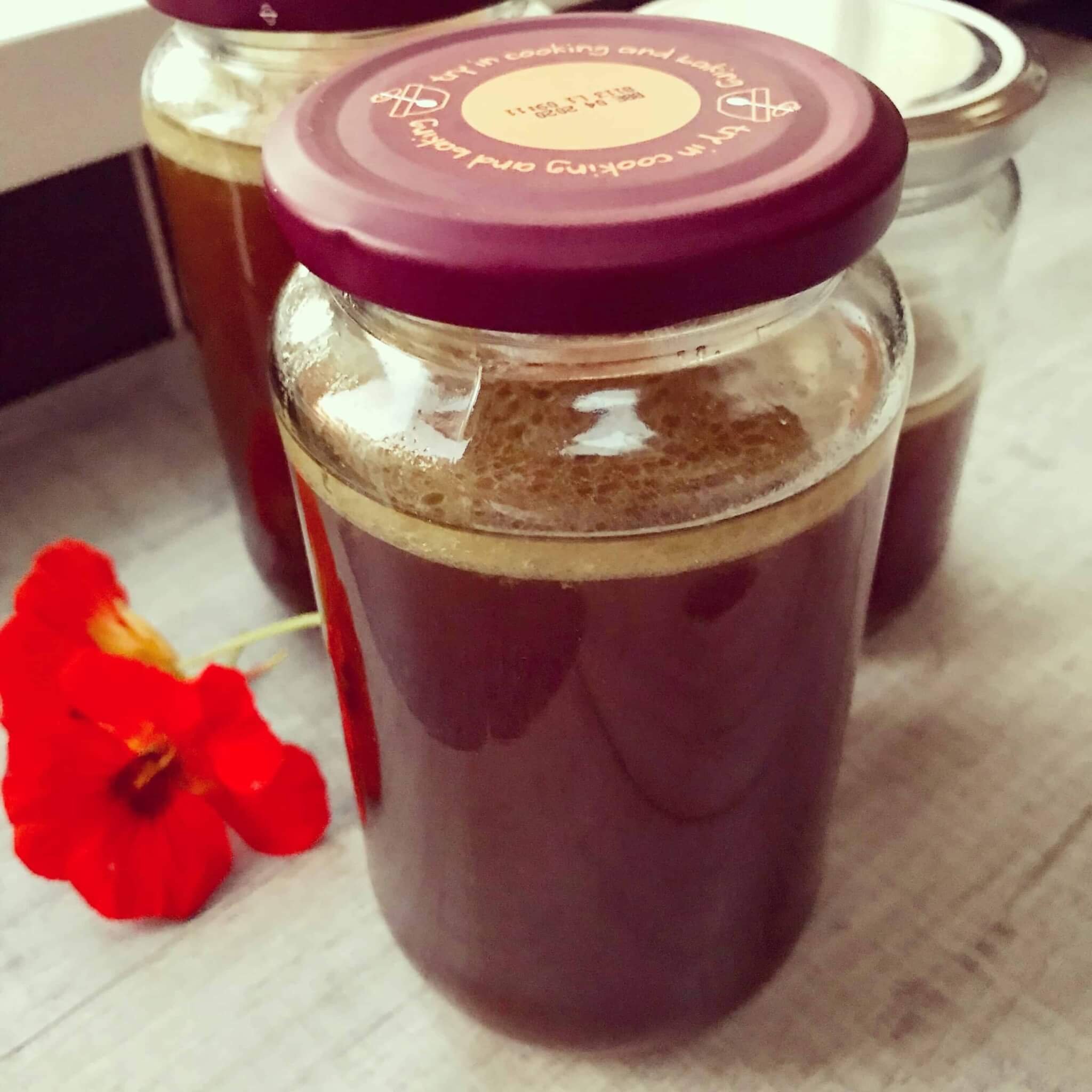
So make this on a day when you've got a bit more in the tank. The pot does most of the work. By evening, your kitchen smells of ginger, thyme and slow-cooked pork, and a row of jars is cooling on the worktop, glowing rich amber in the light.
Then picture one of the harder days. Standing at the hob feels impossible. Even a mouthful of chicken feels like hard work to get down, and you're wearing two jumpers and still can't get warm. But it's already in the fridge. You spoon a wobbly slab of jelly into a pan, and within a minute or two it melts into a savoury, golden-topped broth. Wrap your hands around a hot mug of it and take a sip. You can feel the warmth spread down through your chest and settle in your tummy, like a hug from the inside. It's comforting, soothing and gentle, just what an irritated gut needs.
Or tip a jar into a pan with some leftover meat and a handful of vegetables, and you've got a heartwarming bowl of soup in ten minutes. You know exactly what went into it. On days you're wary of anything new because it might set off a reaction, it's a meal you already trust. (If you react to histamine or alcohol, make your batch without the cider, fish sauce and seaweed. More on that below.) No stock cubes with wheat and nasty additives hiding on the label.

One pot gives you about 3 litres of rich stock and a box of tender trotter meat.
There's just one catch. Bone broth is a brilliant top-up, but its nutrients differ from those in meat and organs, so it can't be your only meal for long. A mug on a rough day is fine; a week of nothing else would leave you short of things your body badly needs.
Pair it with meat, fish, eggs, and organs, especially liver, but also kidney, heart and tongue. (Tongue is a muscle, too, so for some nutrients even tongue beats the most gelatinous stock you've ever made, and this one will be.) More on that below.
It's also a cheap way to eat well. Trotters cost very little, because most people don't know what to do with them.
You're about to find out.
Amber trotter bone broth recipe
Prep: about 5 minutes, plus 15 minutes to blanch the trotters · Cook: 90 minutes (Instant Pot), about 14 hours (slow cooker) or at least 3 hours (hob) · Finishing: 20 to 30 minutes to pick out the bones (less if you use a meat grinder, but then there's the grinder to wash) · Makes: about 3 litres of stock and about 450 g (1 lb) of trotter meat
Bone broth is low in oxalate itself. But collagen is rich in hydroxyproline, which some people convert into oxalate inside the body. If that's you, go gently. (Knight et al., 2006)

Equipment
Instant Pot or other pressure cooker, a slow cooker, or a large stockpot
A large sieve
Large glass jars, such as Kilner jars
A meat grinder (optional, but it makes the trotter meat much easier to use)
Ingredients
2 trotters (pigs' feet), sawn in half crossways by your butcher so they fit the pot, or 3 to 4 pigs' ears
A handful of chicken necks and feet (optional)
Aromatics
2 onions, quartered (if organic, leave the skins on and just remove the roots)
1 head of garlic, peeled
1 leek, washed and cut into 3 pieces
1 to 2 carrots, washed and cut into a few big chunks
1 celery rib, washed and cut into a few big chunks
2.5 cm (1 inch) ginger, thickly sliced
1 bay leaf
5 cloves
¼ tsp whole peppercorns
A few sprigs of thyme and parsley
3 slices dried astragalus root (optional)
A handful of mushrooms (optional): ordinary ones, or shiitake, oyster, shimeji or dried porcini
1 tsp fish sauce
1 tsp apple cider vinegar
1 small piece of seaweed (kelp/kombu, dulse or nori/laver), for a little iodine
1 bottle (about 500 ml) apple or pear cider, organic if you can (optional; see the notes below)
Water
Method
Clean the trotters. Check for hairs, and singe any off over a gas flame or with a kitchen blowtorch.
Put the trotters (or ears) in a large pot, cover with water, bring to a boil and boil for 10 minutes. A lot of scum will form (it's not dirt, but it looks unappetizing). Pour off the scummy water and rinse the trotters.
Put the trotters and all the other ingredients into your Instant Pot, slow cooker or stockpot. Add water up to the max fill line, making sure everything is covered. Instant Pot or pressure cooker: cook on high for 90 minutes, then let the pressure release naturally. In a hurry? Release the pressure manually. Slow cooker: cook on low for about 14 hours. Stockpot on the hob: simmer gently for at least 3 hours. Check now and then, and top up with water so the trotters never dry out.
Let it cool until it's warm to the touch but not boiling. (Never pour really hot liquid into really cold glass, unless you enjoy cleaning up broken glass and spilt stock.)
Lift out the trotters into a large bowl. Discard the aromatics and chicken necks.
Pick out every tiny bone. Each trotter hides two or three that are barely bigger than a pinhead, so feel through the shredded meat with your fingers. Use a skewer or knitting needle to extract the marrow from the longer ones. Shred the meat with two forks or your fingers, or run it through a meat grinder (I recommend this; see the tip below).
Strain the stock through a sieve into large glass jars. Store the stock and the meat in the fridge, or use straight away.
The flavour boosters: cider, fish sauce and seaweed (and when to leave them out)
The cider is optional. It adds depth and a subtle sweetness you won't taste as cider in the finished dish, but it makes the broth really delicious. It also adds a small amount of sugar.
The finished stock has very little alcohol. A 500 ml bottle of cider dilutes into about 3 litres of water, so even if none of it cooked off, a 250 ml mug would hold less than 2 ml of alcohol. In practice, much of it escapes as steam during cooking and when you release the pressure, and more evaporates off when you reheat the broth or cook with it. I've never noticed the slightest effect. If you avoid alcohol completely, though, just leave the cider out.
Most ciders contain sulphites. If you're sensitive to sulphites, look for a cider labelled "no added sulphites". Even those have small natural traces from fermentation, so if you react badly, leave it out. A cup or two of organic dry white wine would probably work instead, though I've never tried it. The same warning about sulphites and biogenic amines, like histamine and tyramine, applies.
Cider, fish sauce and seaweed all nudge up the histamine and tyramine a little. Long-cooked broths can also be higher in histamine.
If histamine is a problem for you, leave out the cider, fish sauce, and seaweed; use the Instant Pot (it's quicker), and cool before freezing any broth you won't consume right away.
If you'd rather start with meat that's never had time to build up histamine and you're in the UK or Ireland, Pheasant's Hill Farm now sells an un-aged, quick-frozen range for histamine intolerance, including quick-frozen trotters. I may have nudged them into it. (It's been a hit.) Tell them I said hi.
Never put anything that's still warm in the freezer. You can use the superfreeze function to freeze things faster, and you can submerge the jar of trotter bone broth in an ice bath once it's cool enough to avoid heat shock that could break the jar, bringing it down to a safe temperature for the freezer more quickly.
The seaweed adds a little iodine. Kelp is very rich in it, so use a small piece. If you have a thyroid condition, dulse or nori have less iodine, or leave the seaweed out.
Why there's no salt
Don't add salt to your stock, and not because of some misplaced fear of sodium. You'll usually use the bone broth as a base for something else, and a long simmer concentrates everything, including salt. Start with perfectly seasoned stock, and you can end up with a stew saltier than the Dead Sea. The teaspoon of fish sauce is the only salt here, and it's very dilute. Season the finished dish to your liking instead.
Then comes the fun part. Leave a jar in the fridge overnight, and in the morning, tip it on its side. Nothing moves. This makes a proper gelatine.

Why won't my bone broth set?
Usually one of three things.
Too much water for the amount of bones. Fill to the max line, but no further; next time, add an extra trotter or a couple of ears.
Not enough connective tissue. Meaty bones add flavour; skin, feet, ears, and knuckles add gel. That's why trotters win.
Boiled too hard or for too short a time. A rolling boil on the hob breaks down the gelatine and clouds the broth. Keep it at a gentle simmer.
Even a runny broth is still a good stock. It just won't win any slicing competitions. However, I've never made a runny stock using trotters. It's more likely to happen with chicken stock.
Trotter tips: the tiny bones and the leftover meat
Trotters have one real drawback: the bones. There are lots of them; they're tiny, and it's almost impossible to find every last one. That's why I grind the meat. Any small bones I miss don't get through the mincing screen.
If you're cooking for a small child, or for anyone who doesn't swallow well, I'd run it through a grinder to be safe. This should catch even the tiniest of bones. Pigs' ears are another option: all connective tissue, with no bones.
You'll get about 450 g (1 lb) of meat from two trotters. There are ideas for using it further down.
What are trotters, and where can you buy them?
Trotters are pigs' feet. In the UK and Ireland, they've fallen out of favour over the last few decades, though in Ireland they used to be sold as crubeens. Around the world, they never went away. They're braised in Chinese ginger-and-vinegar dishes, pickled in the American South, turned into Caribbean souse and Mexican patitas, and roasted as Korean jokbal. Because they're mostly skin, tendons and dozens of tiny joints, they make the richest, most gelatinous bone broth I've ever had.
Alan, the farmer at Pheasant's Hill, reminded me a while back that I once told him pigs' trotters are surprisingly dainty. It seems almost comical that such tiny toes can carry around so much weight. They're a feat of nature's finest precision engineering, and those miniature bones must be doing something incredible. His pigs rule the roost.
Don't eat pork? Cow heel (cow foot) works the same way, and it's a favourite in Caribbean and West African cooking. Chicken feet do too, on a smaller scale.
Never cooked trotters before? Start here
They can look a bit intimidating. Most hurdles are easy to get around.
They're too long for the pot. A whole trotter usually won't fit in a normal stockpot or Ninja Foodie. Ask the butcher to saw them crossways in half to shorten them. I used to buy mine from the Pheasant's Hill Farm stall at St George's Market in Belfast, and the farmer sawed them in half for me so they'd fit in my pots. It was like the magician's classic trick with the beautiful woman. Minus the box. And the beautiful woman. If you can't halve them, don't despair. You can fit whole trotters in a deep roasting dish and braise them in the oven for a few hours instead.
Where to buy them. Ask a butcher; most can get them cheaply, often with a day or two's notice. Chinese, Caribbean, African and Eastern European grocers often sell them, and some farm shops do too. Pastured, outdoor pigs are best if you can get and afford them. My trotters came from heritage Tamworth, Gloucester Old Spots or Iron Age pigs at Pheasant's Hill Farm near Belfast. I've popped out to see them a few times, so I've seen for myself how happy they are. As I mentioned above, you can order their free-range pork trotters from their online shop. They deliver across the UK and Ireland.
Hairs. Look them over, and singe off any stray hairs over a flame.
The smell and the scum. Blanching them first, in step 2, gets rid of most of both. And the smell isn't a sweaty-feet smell anyway.
The tiny bones. See the tip above. It's fiddly, but you only do it once per batch.
Chicken feet and necks, or pigs' ears, can go in the same pot.



What's the difference between stock and bone broth?
Not much, these days. In Europe, "stock" means the rich liquid you get from simmering bones, meat and vegetables, and "broth" used to mean a light soup made with it. Now "bone broth" usually just means a good, long-simmered stock.
People have been doing this for a very long time. Boiling meat and bones probably predates pottery: our hunter-gatherer ancestors may have used hides, bark or animal stomachs as waterproof containers that could endure boiling.
Why make bone broth with trotters?
Connective tissue is the glue that holds you together. That's literal: traditional glues were made from hooves, hides and horns. Your skin, joints, tendons, heart valves, blood vessel walls and gut wall are all built on it.
Its main protein is collagen, the most abundant protein in your body. When you simmer collagen, it turns into gelatine, the wobbly jelly that sets a great broth. Gelatine, pig skin and pigs' ears are among the richest food sources of the amino acids glycine and proline. Dry gelatine has about 19 g of glycine per 100 g, and plain pork skins about 12 g (USDA FoodData Central).
That's why trotters, ears and feet make such a good broth for anyone whose connective tissue is struggling: hypermobility and Ehlers-Danlos syndromes, gadolinium toxicity, or damage after fluoroquinolone antibiotics such as ciprofloxacin. Broth isn't a cure for any of them. But it's a tasty, cheap way to put more of these building blocks on your plate.
I hated jelly as a child, even more than glacé cherries, and I still can't stand it cold, even with meat in it. But I now appreciate that the original jelly was basically sweetened bone broth, which might explain why hospitals served so much of it. It's soft, easy to swallow, doesn't smell strongly, and asks very little of an exhausted person with a gippy tummy.
What bone broth can't do
Bone broth is a wonderful addition to a diet with meat, fish and organs. It can't replace them.
Collagen is low in several building blocks your body needs, including tryptophan, lysine and the sulphur amino acids. It's also a poor source of most vitamins and minerals. If you swap meat for broth, gelatine and collagen powders, you'll run short of protein building blocks and nutrients like zinc, iron, selenium and vitamin B12.
Trotters do come with a little muscle meat attached, so this broth and its meat give you a bit more of those nutrients than many bone broths. It's still nowhere near enough to cover what you need from meat, fish, eggs and organs.
Glutathione, your body's master antioxidant, is a good example. It's made from three amino acids: glycine, cysteine and glutamate. Broth gives you plenty of glycine but very little cysteine. So it can only help if you also eat meat, fish, shellfish, eggs, or organs like liver, kidney, heart, and brain. (If you eat brain, never source it from sheep or goats because of the risk of scrapie.) I explain more about the nutrient differences between bone broths and meats, and why crisps are such a poor snack for the same reason, in Are crisps bad for you?
Will bone broth heal my gut?
You may have come here because you've read that bone broth heals a leaky gut, calms inflammation, or rebuilds your joints and skin. It's a big claim in the ancestral health world, and in diets like GAPS.
Broth is rich in glycine, proline and gelatine, and your body uses those to build and repair connective tissue, including the lining of your gut. In 2025, a gut research team at the Mayo Clinic reviewed the evidence on the main nutrients in bone broth. They concluded these nutrients support the gut barrier and help calm inflammation there, and they called for research into broth for keeping inflammatory bowel disease in remission (Matar, Abdelnaem and Camilleri, 2025). Most of that evidence comes from studies of individual nutrients in animals and people, rather than trials of broth itself.
It's a nourishing food that's easy on a sore gut, that you can eat when not much else appeals, and that puts some nutrients on your plate you'd struggle to get from muscle meat alone. For many people, that's plenty.
If your gut is the reason you're here, this broth is a good start. But gut problems that won't settle usually have more than one thing feeding them, so it helps to look at the whole picture.
So what's been tested in people? More than I expected, yet far less than the wellness world would have you believe.
What does the research say about bone broth, gelatine and collagen?
Nobody has yet run a proper randomised trial of bone broth itself, for the gut or anything else. Almost all human studies used glycine, gelatine, or collagen supplements at a measured dose. A home-made broth varies from batch to batch, and nobody has measured how much a trotter broth like this one gives you. It sets far firmer than most broths, though, which tells you it's packed with gelatine.
Sleep and tiredness. In healthy volunteers whose sleep was cut short for three nights, 3 g of glycine before bed reduced fatigue the next day and improved alertness on a reaction test. It's a small study by researchers at Ajinomoto, a company that sells glycine (Bannai et al., 2012).
Building collagen. In 8 young men, 15 g of gelatine with vitamin C, taken an hour before a short burst of exercise, doubled a blood marker of collagen being made (Shaw et al., 2017).
Sore knees. A review of 11 trials, with 870 people, found collagen supplements eased the pain and stiffness of knee osteoarthritis compared with a placebo. The trials varied widely in what they used and how they measured it (Simental-Mendía et al., 2024).
Tendons. In 20 people with a painful Achilles tendon, collagen peptides plus calf exercises resulted in faster improvement than the exercises with a placebo (Praet et al., 2019).
Bones. In 131 postmenopausal women, 5 g of collagen peptides daily for a year led to small gains in bone density in the spine and hip (König et al., 2018).
Muscle. In 53 older men with muscle loss, collagen peptides plus strength training built more muscle and strength than training alone (Zdzieblik et al., 2015). A smaller trial in healthy older men found no clear extra benefit (Centner et al., 2019). Researchers from the company that makes the collagen worked on the bone study and the first muscle study.
"Jewish penicillin". Granny's chicken soup isn't entirely an old wives' tale. In 15 healthy people, sipping hot chicken soup cleared nasal mucus a little faster than hot water, though the effect wore off within half an hour (Saketkhoo et al., 1978). In a petri dish, chicken soup also slowed down the white blood cells that drive inflammation (Rennard et al., 2000). That second study wasn't done in people.
Soup eaters. Across 7 studies of over 45,000 people, soup eaters were less likely to be obese (Kuroda and Ninomiya, 2020). In 4,158 American adults, soup eaters had smaller waists (Zhu and Hollis, 2013). And in 9,364 Japanese adults, people who drank miso soup every day reported less reflux and indigestion (Mano et al., 2018). These studies show a link. They can't show the soup caused it, because soup eaters may differ in other ways. The first review was also written by researchers at Ajinomoto, which makes soup stocks and seasonings.
None of this proves broth cures anything. Its building blocks do measurable things in the body, though, and people who eat a lot of soup seem to do well on it.
Until someone funds a proper trial of trotter broth (I won't hold my breath; nobody can patent a pig's foot), I'll keep making it anyway.
How to use trotter bone broth: your secret weapon at the dinner table
Plenty of people drink a mug of hot bone broth every day, alongside their meals. I mostly cook with it, anywhere you'd reach for a stock cube or plain water.
You'd never know it was made with trotters. Nobody sees the pig's feet. They just notice that your gravy is glossier, your stew is richer, and your soup has a depth they can't quite put their finger on. It's a delicious je ne sais quoi that can turn a simple dish into something people ask for again and again.
If you cook for picky eaters who'd be horrified to find out what's in their dinner, you don't have to tell them. I'd almost guarantee they'll prefer it to supermarket stock cubes. Your secret's safe with me.
The French already know this. Some cooks add trotters to their cassoulet, and once you've tasted this broth, you'll understand why it makes the dish such a hit.
So the same jars that see you through the hard days also make your good-day dinners taste better. One batch, both jobs.
Ways to use the broth
Braises, stews and casseroles: use it instead of stock or water, like in this beef, beetroot, prune, orange and chocolate stew, a slow-cooked pulled beef brisket or a pulled pork with medicinal mushrooms.
Gravies and sauces: the gelatine gives them body and a glossy shine, so they cling to the meat without flour or cornflour. Use a splash to loosen the sticky bits at the bottom of a roasting tin or frying pan.
Soups: the base for butternut squash soup, cream of mushroom soup, or your own take on French onion soup.
Vegetables: lightly boil them in broth instead of water, or braise them in the oven with a ladleful. Don't throw away the cooking water. Sip it as is, or blend it with a few more ingredients to make a soup.
Rice and other grains: cook them in broth instead of water, for risotto, pilaf, or a kedgeree that tastes of so much more than rice and fish. Just make sure to soak and wash the rice well first to remove as much arsenic as possible.
Poaching: gently poach chicken, fish or eggs in it.
A quick meal in a mug: heat it with a little leftover meat, a few greens (not oxalate-laden spinach or chard if you value your health!) and a squeeze of lemon or a dash of fish sauce.
Ways to use the trotter meat
Stir a little into minced pork, lamb or beef for shepherd's pie, moussaka, chilli, ragù, meatballs or burgers. It adds flavour and keeps them moist.
Fry it in a hot pan until the edges crisp, and scatter it over soups or salads.
Add it back into a bowl of the broth with some vegetables for a quick, filling soup.
Any leftover pigskin can go into these oven-baked pork rinds.
If you fancy packing the meat into a dish with a little warm broth and letting it set into a terrine, or brawn, I won't stand in your way. It's not to my taste, and I've never tried it.
I don't include calorie counts for my recipes. Counting calories makes little sense, and it can put you in a mindset that does more harm than good.
Frequently asked questions
Is bone broth good for you?
It can be a nourishing addition to your diet, alongside meat, fish, eggs and organs. Broth made from collagen-rich parts like trotters, ears, tails, necks, and feet is rich in glycosaminoglycans (animal fibres), gelatine and the amino acids glycine, hydroxyproline, and proline, which your body uses to build connective tissue. It's also an easy, gentle way to eat when you're tired, or your gut is sore. Claims that bone broth heals specific conditions may go further than the evidence, though. And it can't replace meat, fish, eggs and organs, because collagen is low in several essential amino acids, vitamins and minerals.
Why doesn't my bone broth gel?
Usually there's too much water for the bones, not enough collagen-rich parts, or it was boiled too hard. Skin, feet, ears, and knuckles provide the gel; meaty bones mostly provide flavour. Fill only to the max line, add an extra trotter or a couple of pigs' ears next time, and keep the pot at a gentle simmer on the hob. A runny broth is still a good stock.
Can I make bone broth in an Instant Pot?
Yes, and it's the fastest way. Cook under high pressure for 90 minutes, then let the pressure release naturally. Pressure cooking pulls a lot of gelatine out of trotters in a fraction of the time a stockpot takes. A slow cooker on low for about 14 hours, or a gentle simmer on the hob for at least 3 hours, also works.
How long does bone broth keep?
US food safety guidance gives 3 to 4 days in the fridge for soups and stews with meat or vegetables, and 2 to 3 months in the freezer before the quality starts to drop (FoodSafety.gov). I always plan how much I'll use in the next few days and freeze the rest right away. Freeze in amounts you expect to use each time you defrost, such as ice-cube trays for sauces and jars for soups, and leave room at the top for it to expand.
Can I live on bone broth for a few days?
Don't try this too often, and not for long. A mug when you can't face a meal or the odd day here and there is fine. But bone broth is low in several essential amino acids and most vitamins and minerals, so going a whole day without anything else should be unusual, and whole weeks would leave you short of what meat and organs provide. If you're too unwell to eat for days at a time, that's a reason to get help.
What can I use trotter bone broth for?
Use it anywhere you'd use a stock cube or water. It makes rich braises, stews and casseroles, glossy gravies and sauces, and a good base for soups such as butternut squash, cream of mushroom or French onion. Cook rice for risotto or kedgeree in it, poach chicken, fish or eggs in it, or boil vegetables in it and drink the cooking water. Nobody will guess that it was made with trotters, so it works for fussy eaters too.
Is there alcohol in bone broth made with cider?
Very little. The cider is diluted in about 3 litres of water, so even if none cooked off, a 250 ml mug would hold less than 2 ml of alcohol. Much of it escapes as steam while it cooks and when you reheat it, though a small amount can remain. Leave the cider out if you avoid alcohol completely. Most ciders also contain sulphites, so leave it out if you're sensitive to them.
Can bone broth replace meat?
No. Collagen is low in tryptophan, lysine and the sulphur amino acids, and it isn't a good source of most vitamins and minerals. If you rely on bone broth, gelatine, or collagen instead of meat, you'll run short of protein-building blocks and nutrients like zinc, iron, selenium, and vitamin B12. Use it alongside meat, fish, shellfish, eggs and organs, not instead of them.
Is bone broth high in oxalate?
Bone broth itself should contain very little oxalate (don't start adding spinach or beetroot to it!). But collagen is rich in hydroxyproline, proline, and glycine, and your body converts some of these into oxalate, especially if you're vitamin B6 deficient or have genetic mutations that affect the metabolism of these amino acids. Most people handle that without trouble. If you already struggle with oxalate, for example with kidney stones or oxalate-related symptoms, go gently with large amounts of broth, gelatine and collagen supplements, and watch how you feel.
If your gut, joints or energy still aren't right
Maybe you've tried the broth, the supplements and the "healthy" diet, and you still feel exhausted, bloated, sore or foggy. Maybe you've been told it's IBS, or to learn to live with it. Book a free 90-minute video call with me. That's about six times longer than a typical GP appointment, so there's time to go through your whole story. You'll leave knowing which pieces matter most for you, and where I'd focus through food, supplements and lifestyle. A partner or family member is welcome to join you.
Sources
Knight J, et al. Hydroxyproline ingestion and urinary oxalate and glycolate excretion. Kidney International. 2006. https://doi.org/10.1038/sj.ki.5001906
USDA FoodData Central: gelatin, dry powder (FDC 169599); pork skins, plain (FDC 167961); pork ears, frozen, simmered (FDC 167858).
Stone Age stew? Soup making may be older than we'd thought. NPR, 2013.
FoodSafety.gov. Cold food storage chart. https://www.foodsafety.gov/food-safety-charts/cold-food-storage-charts
Matar A, Abdelnaem N, Camilleri M. Bone Broth Benefits: How Its Nutrients Fortify Gut Barrier in Health and Disease. Digestive Diseases and Sciences. 2025;70(6):1951-1961. https://doi.org/10.1007/s10620-025-08997-x
Bannai M, et al. The effects of glycine on subjective daytime performance in partially sleep-restricted healthy volunteers. Frontiers in Neurology. 2012;3:61. https://doi.org/10.3389/fneur.2012.00061
Shaw G, et al. Vitamin C-enriched gelatin supplementation before intermittent activity augments collagen synthesis. American Journal of Clinical Nutrition. 2017;105(1):136-143. https://doi.org/10.3945/ajcn.116.138594
Simental-Mendía M, et al. Effect of collagen supplementation on knee osteoarthritis: an updated systematic review and meta-analysis of randomised controlled trials. Clinical and Experimental Rheumatology. 2024;43(1):126-134. https://doi.org/10.55563/clinexprheumatol/kflfr5
Praet SFE, et al. Oral supplementation of specific collagen peptides combined with calf-strengthening exercises enhances function and reduces pain in Achilles tendinopathy patients. Nutrients. 2019;11(1):76. https://doi.org/10.3390/nu11010076
König D, et al. Specific collagen peptides improve bone mineral density and bone markers in postmenopausal women: a randomized controlled study. Nutrients. 2018;10(1):97. https://doi.org/10.3390/nu10010097
Zdzieblik D, et al. Collagen peptide supplementation in combination with resistance training improves body composition and increases muscle strength in elderly sarcopenic men. British Journal of Nutrition. 2015;114(8):1237-1245. https://doi.org/10.1017/S0007114515002810
Centner C, et al. Effects of blood flow restriction training with protein supplementation on muscle mass and strength in older men. Journal of Sports Science and Medicine. 2019;18(3):471-478. PMID 31427869
Saketkhoo K, et al. Effects of drinking hot water, cold water, and chicken soup on nasal mucus velocity and nasal airflow resistance. Chest. 1978;74(4):408-410. https://doi.org/10.1378/chest.74.4.408
Rennard BO, et al. Chicken soup inhibits neutrophil chemotaxis in vitro. Chest. 2000;118(4):1150-1157. https://doi.org/10.1378/chest.118.4.1150
Kuroda M, Ninomiya K. Association between soup consumption and obesity: a systematic review with meta-analysis. Physiology and Behavior. 2020;225:113103. https://doi.org/10.1016/j.physbeh.2020.113103
Zhu Y, Hollis JH. Soup consumption is associated with a reduced risk of overweight and obesity but not metabolic syndrome in US adults: NHANES 2003-2006. PLoS One. 2013;8(9):e75630. https://doi.org/10.1371/journal.pone.0075630
Mano F, et al. Reduction in gastroesophageal reflux disease symptoms is associated with miso soup intake: the Nagahama Study. Journal of Nutritional Science and Vitaminology. 2018;64(5):367-373. https://doi.org/10.3177/jnsv.64.367